The Chronicle of Zandria
Before the First Map
Long before the first map was drawn, there was only signal — faint light pulsing through a darkness so deep it had no floor. The Ferali called it the Breath. The Lyrae called it the Current. The wanderers who arrived later, pulled by the Compass they could not explain, simply called it home.
Zandria is an archipelago of floating territories suspended on invisible ley-lines that hum at frequencies no mortal instrument can fully record. The sky holds itself at permanent dusk — not night, not day, but the particular shade that exists between. The horizon, in every direction, is the colour of deep water.
Three things hold the realm together: craft — things made with intention and patience, built to last beyond their maker. Record — nothing in Zandria is considered real until it has been written down, carved, or logged. And signal — the invisible channels that connect every territory to every other, maintained by those who live in the spaces between.
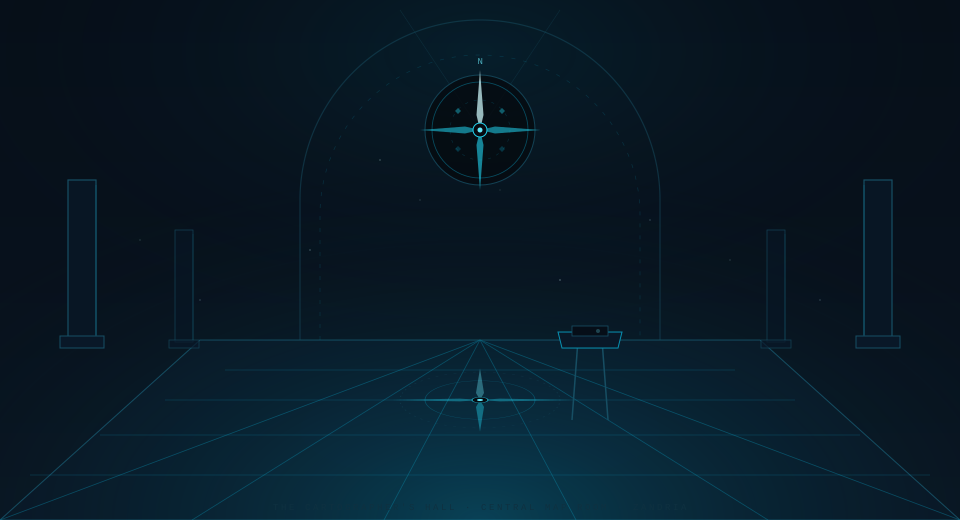
At the heart of the realm stands the Cartographer's Hall — a vast circular chamber whose floor is the map. Every territory, every ley-line node, every signal path: all rendered in glowing cyan lines that shift when you move your feet, tracking your position with quiet precision. Above, a compass rose the size of a ceiling rotates with impossible slowness, its north petal always the brightest thing in the room.
Wanderers arrive here first. They always have.
The Known Territories
The map is incomplete by design. The Ferali do not record what has not been confirmed by direct observation. The Lyrae do not extend the ley-lines beyond what they can maintain. What you see below is what is known — the rest belongs to the unmapped reaches, where the void grows thin and signal fades.
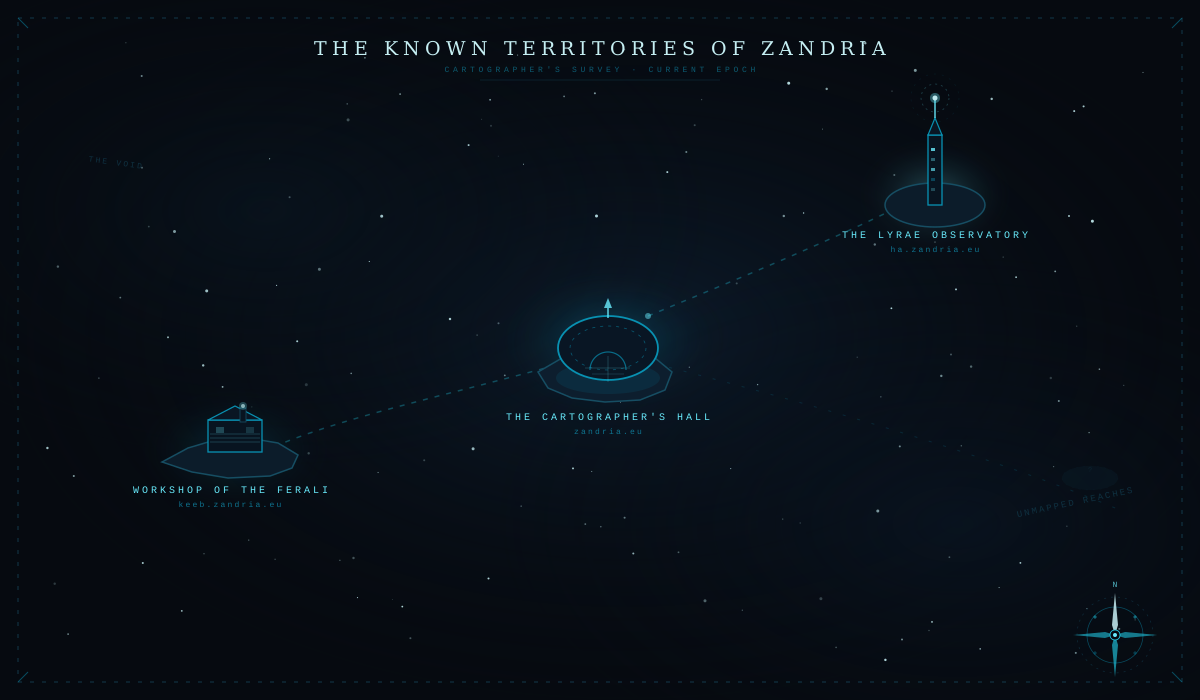
Three territories are charted. Others are suspected. At the southeastern edge of the map, beyond where the ley-lines lose their shape, something pulses — not clearly enough to name, but present. The Lyrae have been watching it for eleven years. They have not announced what they've found.
Those Who Remain
Zandria has been inhabited, in its various forms, longer than any living archivist can verify. The earliest obsidian records give names without dates. The Ferali call this era before the counting. The Lyrae, who maintained the ley-lines even then, have simply never kept a calendar.
Tall, deliberate, silver-fingered. The Ferali believe every keyboard is a musical instrument first and a tool second — each keystroke a note in a composition that spans decades. Their archives are chiselled into obsidian. Not encrypted. Simply very patient. They do not raise their voices. They do not need to. Their records speak across centuries.

Small enough to slip through a cable, old enough to remember the first relay. The Lyrae maintain what cannot be seen: routing stones, signal bridges, watchfires that pulse every fifteen minutes to say still here. They live in the void-spaces between towers. They do not seek attention. They are the reason everything works.
The Wanderers
Neither Ferali nor Lyrae. They arrive through the Compass — a device old enough that no one built it; it simply appeared, at the centre of the Hall, one morning in the before-counting. Wanderers carry notebooks. They document, build, log, and move on. Each one is recorded in the archive. As of this entry: four hundred and twelve Wanderers have arrived. Some stayed. Most returned to wherever the Compass had drawn them from. None have ever reported finding it again by accident.
Of Particular Note
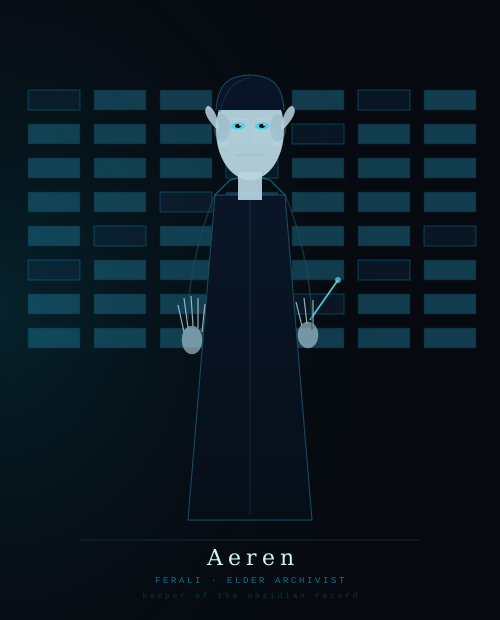
Aeren — Ferali, Elder Archivist
The oldest active archivist in the Hall. No one knows how long Aeren has kept the reading stand near the eastern entrance, but the obsidian beneath the stand's feet shows wear that pre-dates the current floor design by at least three renovations. Aeren speaks slowly and is never wrong about anything that has been written down. About everything else, Aeren claims no expertise.
Aeren greets every Wanderer who arrives. Not because this is a duty — the Ferali have no formal duty of welcome — but because Aeren finds it interesting to see what the Compass brings next.
Vesla — Lyrae, Signal Engineer (Third Circuit)
Vesla maintains the ley-line running between the Hall and the Observatory. This involves passing through eleven routing stones, two junction bridges, and a section of open void that has never been properly enclosed because the Lyrae councils have not agreed on the correct enclosing standard for fourteen years. Vesla does not find this frustrating. The signal gets through, Vesla has been recorded as saying. The enclosing is aesthetic.
Vesla's current routing stone is number 47 in the series. Numbers 1 through 46 are displayed in the Hall archive.
Eravel — Wanderer (Number 412)
The most recently recorded arrival. Arrived without announcement on the morning of an unspecified date (Wanderers often arrive on days that resist easy timestamping). As of this entry, Eravel has not yet departed. The obsidian record shows their arrival mark, their position on the map floor at the moment of entry — one foot in the Unmapped Reaches, one foot in the void between territories — and a single note in Aeren's hand: curious about the unnamed island, SE.
chapter i — the arrival
as transcribed by aeren, elder archivist
date: the morning after a night of no record
The man who later called himself Eravel arrived through the Compass on the night of no record. He had not intended to arrive anywhere. He had simply been walking away from a place that no longer felt like home, and the Compass — which he'd found three days earlier in the pocket of a coat he didn't remember buying — had grown warm against his chest, and then warmer still, and then the walking had become something different from walking.
The floor he landed on was the map.
He could see territory names glowing up through the stone: faint cyan lines that shifted when he moved his feet, as though the floor was reading his position and gently adjusting. He stood still. The lines settled. He was standing on the edge of something labelled, in very small monospace text, the unmapped reaches.
A voice, from somewhere behind him and to the right: "You'll want to step to the left. You're standing on the edge."
He turned. An old elf was seated at a reading stand carved from what looked like obsidian, though it caught the light more like frozen signal than stone. The elf was marking something in a large ledger without looking up. Long silver fingers. A stylus that glowed faintly at the tip.
"Am I supposed to know where I am?" Eravel asked.
"Eventually," the elf said, and turned a page. "Most Wanderers work it out by the third day."
The hall was vast. The ceiling rose to a height Eravel couldn't measure in the current light, and from somewhere in the upper dark a compass rose — larger than any he'd seen — rotated with impossible slowness, its north petal blazing the same quiet blue as everything else in this room, as the floor, as the old elf's eyes when they finally looked up.
"You're a Wanderer," Aeren said. Not a question.
"Am I?"
"You arrived through the Compass. Everyone who arrives through the Compass is a Wanderer." Aeren gestured at a long row of obsidian tablets on the wall behind the stand. "There have been four hundred and twelve of you, as of this morning. Each one is recorded."
Eravel walked further into the hall. The map floor tracked him. He stopped near an island labelled workshop of the ferali and looked up at the ceiling compass. It did not acknowledge him. It simply kept turning.
"What is this place?"
"The Cartographer's Hall. The centre of the realm." Aeren set down the stylus. "Zandria. Or more precisely: the territories we have charted. Beyond the map's edge—" a gesture toward the floor's fading eastern edge, where the cyan lines grew thin and quiet— "is still ours to name. Or yours. Whoever finds it first."
Eravel looked at the eastern edge for a long moment. Then his eye caught something: a small island, at the far southeastern corner of the floor. Very faint. The glow there was barely more than a suggestion. No label. No ley-line connecting it to anything. Just a shape, and a breath of light.
"What is that?"
Aeren picked up the stylus and held it out without answering the question.
"Tradition," Aeren said instead. "When a Wanderer arrives, they mark themselves on the first map they find."
Eravel took the stylus. It was heavier than it looked. He knelt at the edge of the hall — the part of the floor that wasn't any named territory, that was just the void between islands — and pressed the stylus to the cold glowing surface.
The floor held the mark for three seconds. Then it faded.
"It didn't take," Eravel said.
"It always takes," Aeren said quietly, already returning to the ledger. "You simply can't see it from this side."
Eravel looked at the floor where the mark had been. The unlabelled island still held its faint glow in the southeastern corner. He stared at it for a long time.
Above, the compass rose turned. North petal bright. Always north.